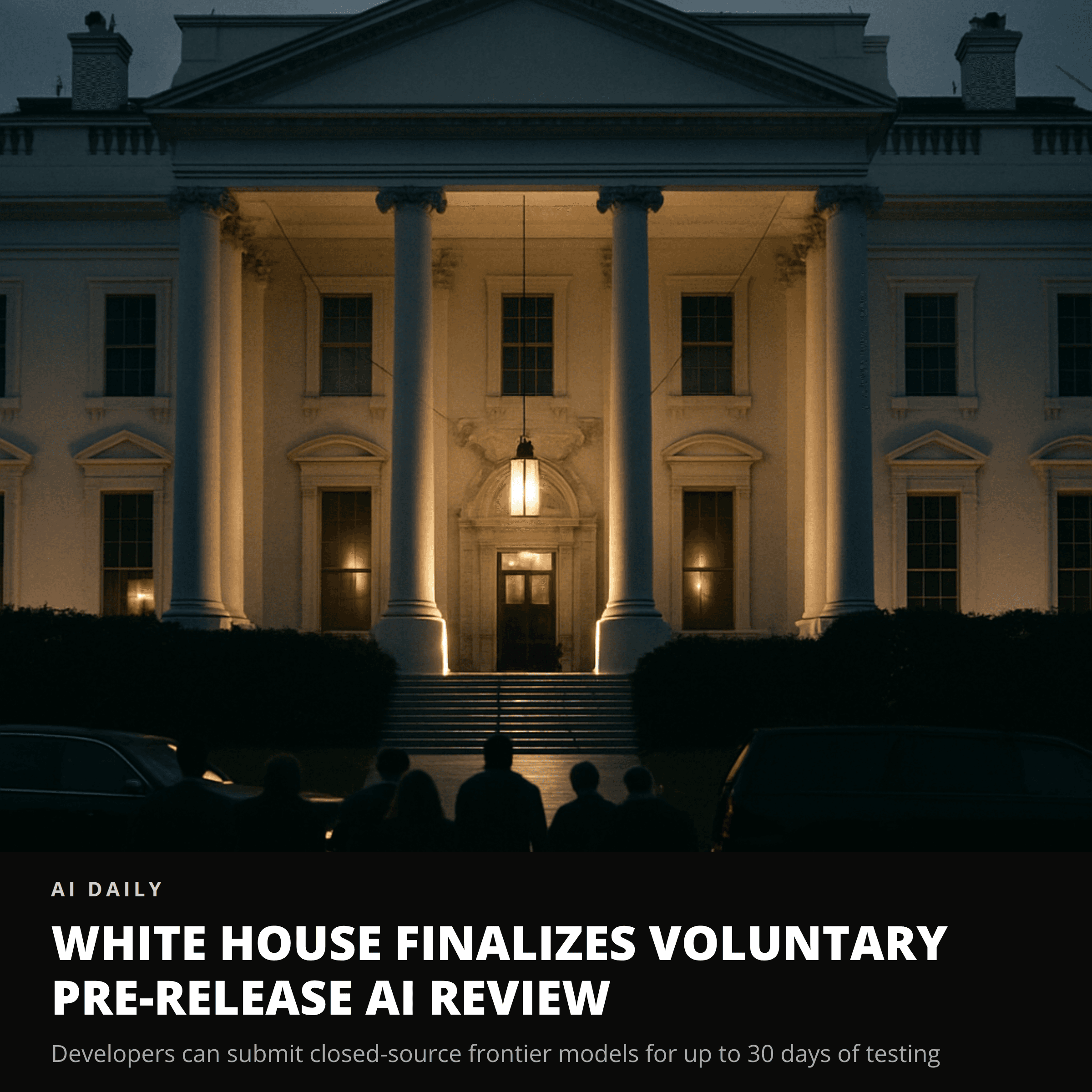
We covered the first reports a few days ago, now the White House has finalized a voluntary process that lets federal experts test powerful AI models before they are released.
Under the framework, developers can submit certain advanced, closed-source models for a government safety and cybersecurity review. Agencies may get access for up to 30 days before wider deployment, and joining the process is voluntary, not a licensing or preclearance requirement.
The regime is narrowly targeted. It applies mainly to proprietary systems whose performance suggests they could be used for offensive hacking or other high-risk misuse. Open-source or “open-weight” models from U.S. firms are explicitly exempt, open-weight means the company publishes the model’s internal parameters so anyone can run or modify it, a choice intended to avoid slowing freely shared tools.
Why this matters: it creates an official, pre-release pathway for the government to hunt for cybersecurity and national-security risks rather than responding after a problem appears. The White House has already invited major developers, including OpenAI, Anthropic, Google, Microsoft and Meta, to discuss the process.
Think of it as a short, targeted safety inspection. Federal experts get a fixed window to try to break the model and probe whether it could be turned into a cyber-weapon or used to compromise critical systems. Most of the technical checklist will remain non-public, and only participating firms will see the full criteria.
What changes now is mostly procedural and political. Big labs gain a way to get government feedback before a launch; open researchers keep the freedom to publish without entering that review; and the public gains a safety mechanism that will be harder to audit because much of it is classified.
The real test is whether companies actually volunteer when the stakes are highest. Will firms welcome a quiet government review to reduce risk, or will they prefer public launches and independent scrutiny? How they answer will shape whether this becomes a routine safety step or a narrow national-security tool.