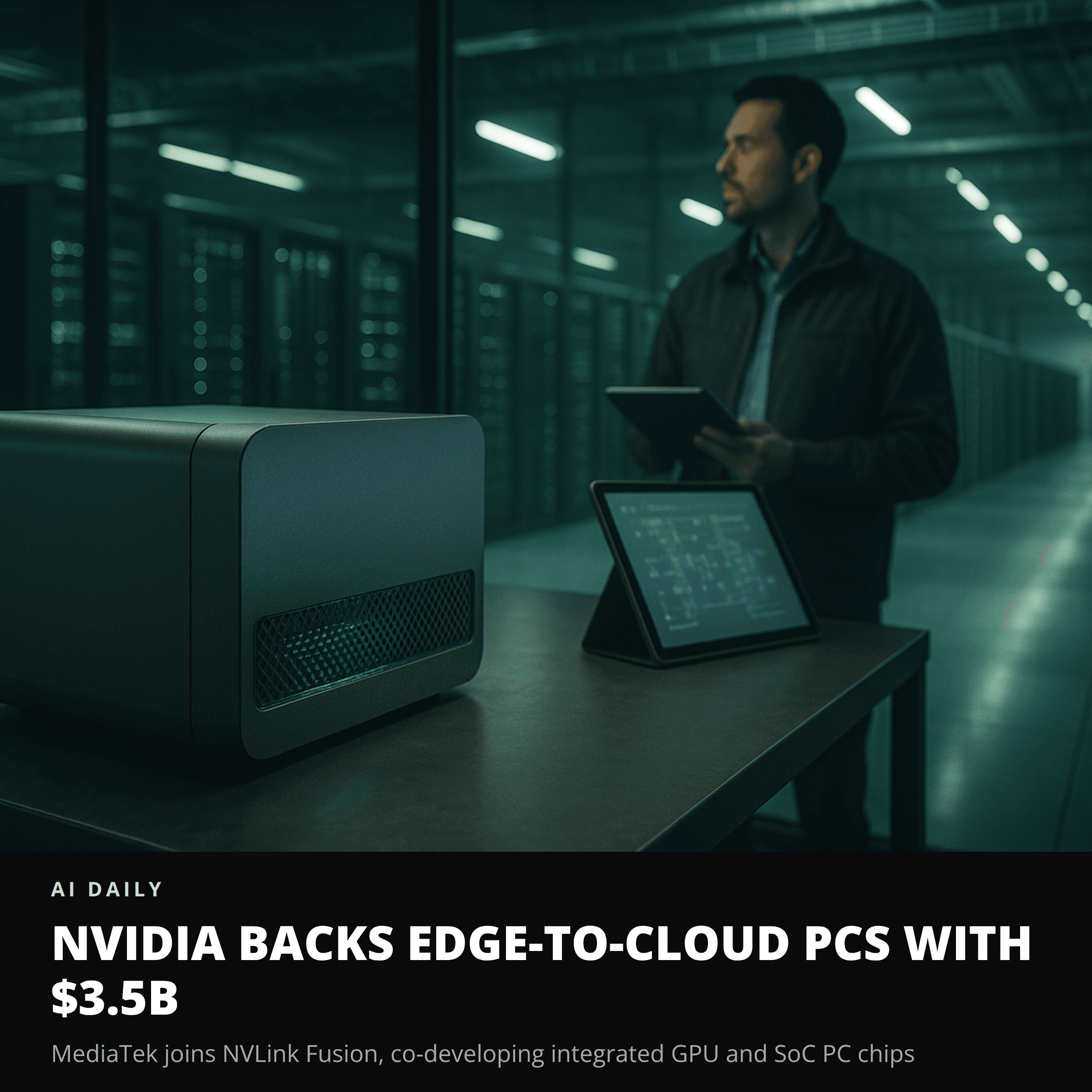
The long gap between datacenter AI and everyday PCs is narrowing into a real commercial plan.
On August 31, 2026, NVIDIA and MediaTek announced an expanded partnership to build AI platforms that span infrastructure, local computing and automotive. MediaTek will join NVIDIA’s NVLink Fusion ecosystem, and the two companies will co‑develop multiple generations of RTX Spark and DGX Spark PC chips that combine NVIDIA GPUs with MediaTek system‑on‑chips (SoCs). NVIDIA is supporting the effort with a $3.5 billion convertible bond investment, reported at roughly 4.8 trillion won.
Why this matters: the deal pairs NVIDIA’s datacenter compute with MediaTek’s low‑power chip design. That combination can make tightly integrated AI systems cheaper to build and easier to move between a workstation and a rack. In plain terms, makers can design one stack that scales from local developer machines up to rack‑scale AI factories.
How it works, at a glance: NVLink Fusion lets many servers talk to each other like lanes on a high‑speed highway, so racks behave as a single computer. The co‑developed chips put high‑power GPUs and efficient SoCs on the same board, so workloads can run locally or be stitched into larger clusters without rewriting them.
What changes now: OEMs and enterprises can plan end‑to‑end hardware that is purpose‑built for AI, not assembled from mismatched parts. Developers may be able to prototype on powerful local workstations and then scale designs to datacenters more smoothly. Practical limit: this still requires significant engineering and data‑center class infrastructure, so it won’t make cutting‑edge AI universally laptop‑friendly overnight.
What to watch next: will closer ties between GPU and SoC suppliers create real, interoperable products that compete with today’s cloud stacks, or will it simply deepen existing vendor advantages? Product rollouts, benchmarks and OEM adoption will answer that.