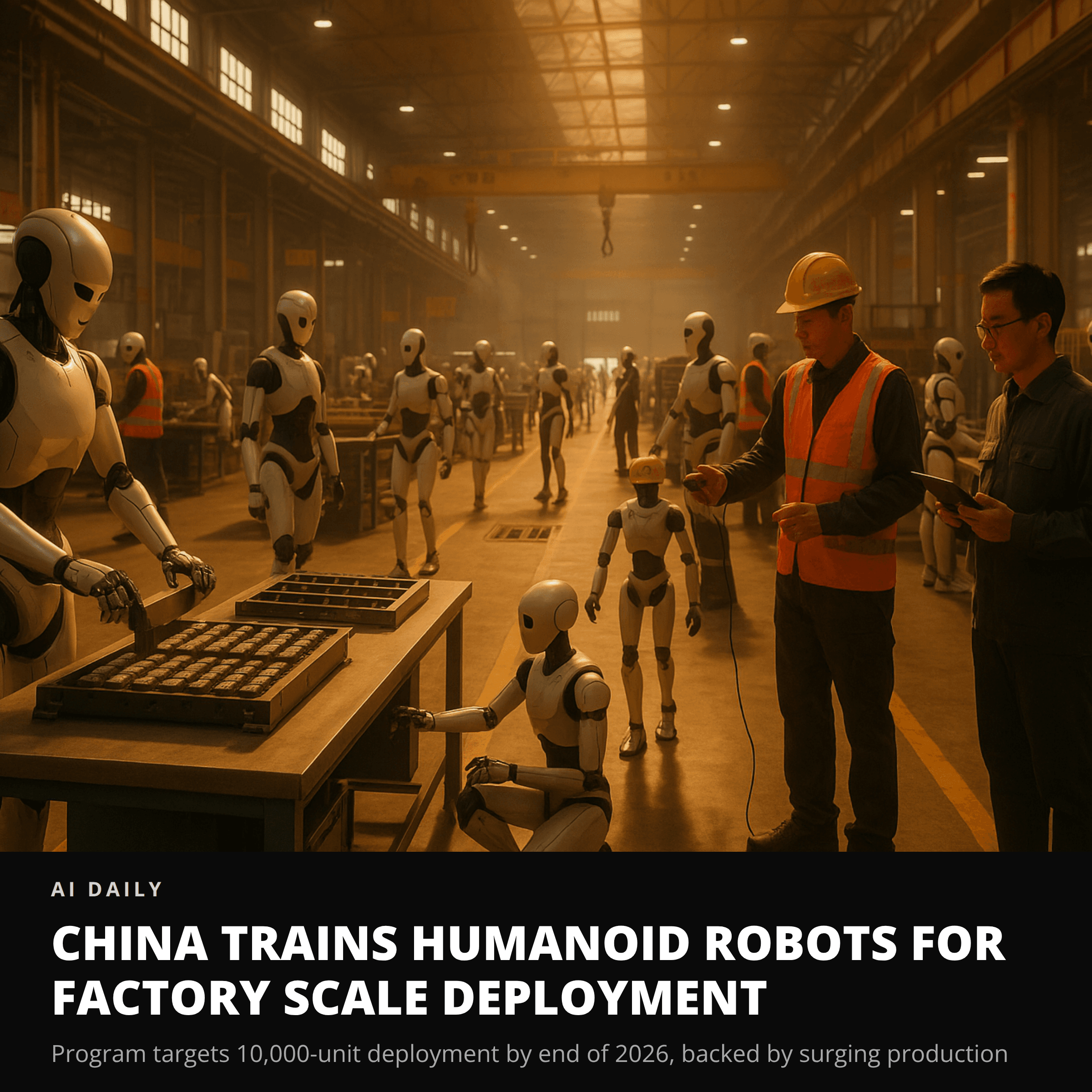
More than 100,000 humanoid robots are projected to be produced in 2026.
China’s Ministry of Industry and Information Technology and its state assets regulator have launched a program to train humanoid robots and embodied AI systems in real factories and logistics hubs. The program sets an explicit objective of building deployment capacity at the 10,000-unit scale by the end of 2026. Officials reported output of about 20,000 humanoid units in 2025, more than 40,000 units in the first half of 2026, and a projection to exceed 100,000 units for the full year. MIIT data also show more than 400 distinct humanoid robot products developed domestically, and Chinese-made quadruped robots account for nearly 70 percent of global sales.
Those are not just production numbers. They mark a policy choice to move robots out of labs and into active industrial roles. The program targets training robots in operational settings, which is a direct response to the gap that often exists between prototype demos and reliable, repeatable deployment. Government leadership from an industry ministry and the state assets regulator means the program will likely prioritize integration with large manufacturers and state-owned enterprises where scale can be tested rapidly.
High output and broad product variety give China options: low-cost units for routine tasks, specialized models for assembly, and rapid iteration driven by volume. At the same time, producing robots is easier than making them useful in real operations. Successful deployment at scale will demand standards for performance and safety, supply chains for spare parts, new maintenance and retraining programs for human workers, and infrastructure changes on factory floors.
For global firms and investors, the development matters because availability at scale shortens the timeline for adoption decisions. Procurement, workforce planning, and capital expenditure cycles should account for a faster cadence of embodied AI solutions arriving from a single, well-coordinated market.
If the program reaches its targets, 2026 will be the year humanoid robots stop being a recurring demo and start becoming a routine industrial tool. That will raise practical questions about how factories are organized, who owns the integration process, and which rules will govern humans and machines working side by side.