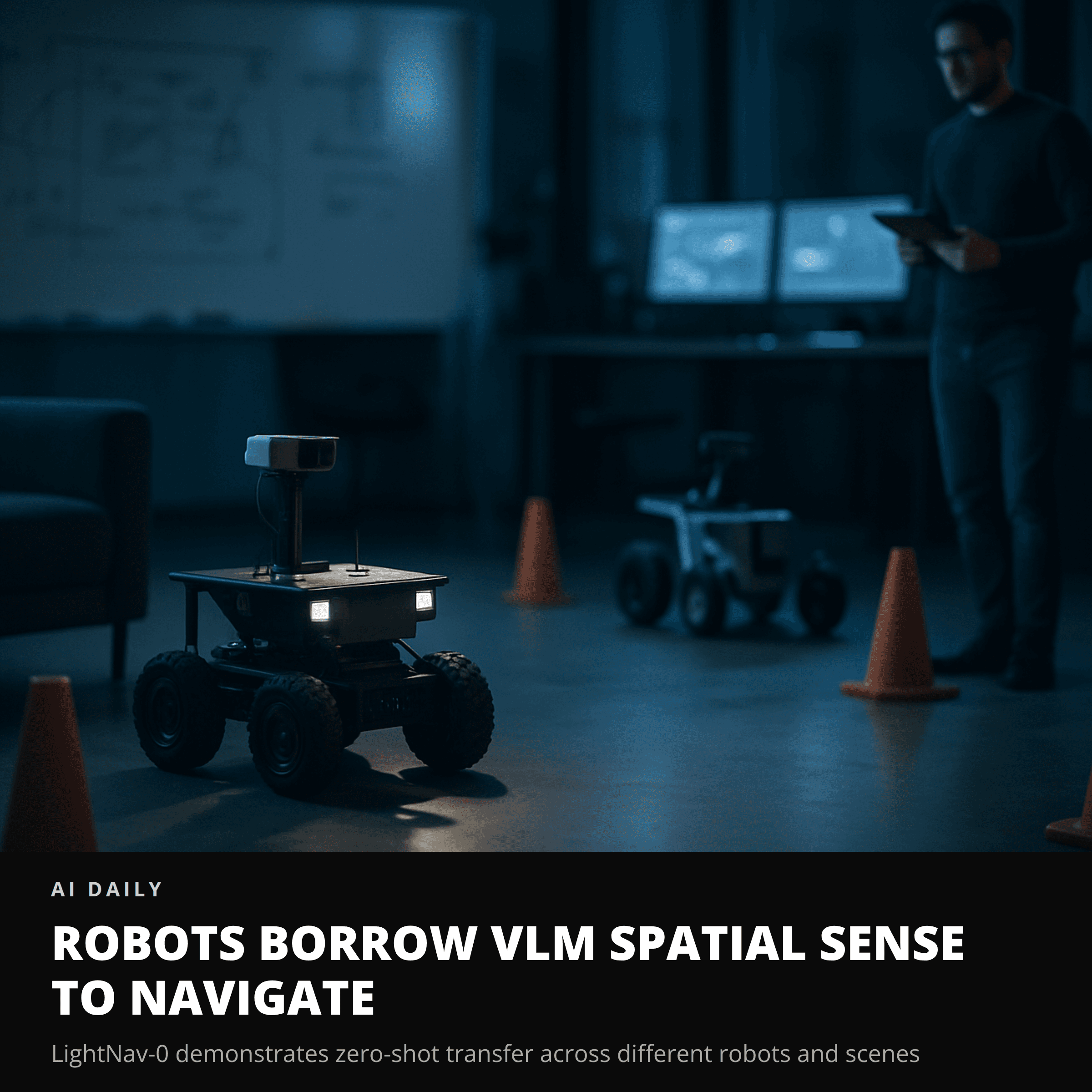
Robots can now borrow a vision-language model's sense of space to navigate different bodies and environments without task-specific retraining.
A team at Light Origins published LightNav-0, a navigation approach that plugs a pretrained vision-language model into embodied control. Instead of adding a new prediction head for each task or robot, LightNav-0 uses a shared token interface: one channel points to spatial goals in a task-agnostic way, and a compact tokenizer translates a particular robot's motions into a form the vision model can predict.
Why that matters is simple: until now, state-of-the-art navigation systems were built and tuned per platform. LightNav-0 shows you can reuse a model's visual and spatial reasoning across robots and scenes, shrinking the engineering work needed to get a robot moving intelligently in a new setting.
How it works, in one image: think of a single map reader that understands photos and language. Instead of telling it a new set of driving rules for each vehicle, you give it a short pointer to where to go and a small, shared shorthand that describes how that vehicle moves. The model then plans trajectories in that shared language.
On benchmarks this paid off: the paper reports top monocular success rates across the evaluated simulation tasks, and the authors demonstrate zero-shot transfer to different real robots and scenes without extra fine-tuning. This is laboratory-grade evidence, not a product launch, so real deployments will still need hardware integration and safety testing.
The open question is whether independent teams can reproduce these gains in messier, long-running field trials, and whether VLM-derived spatial skills become a standard building block for generalist robotics.